
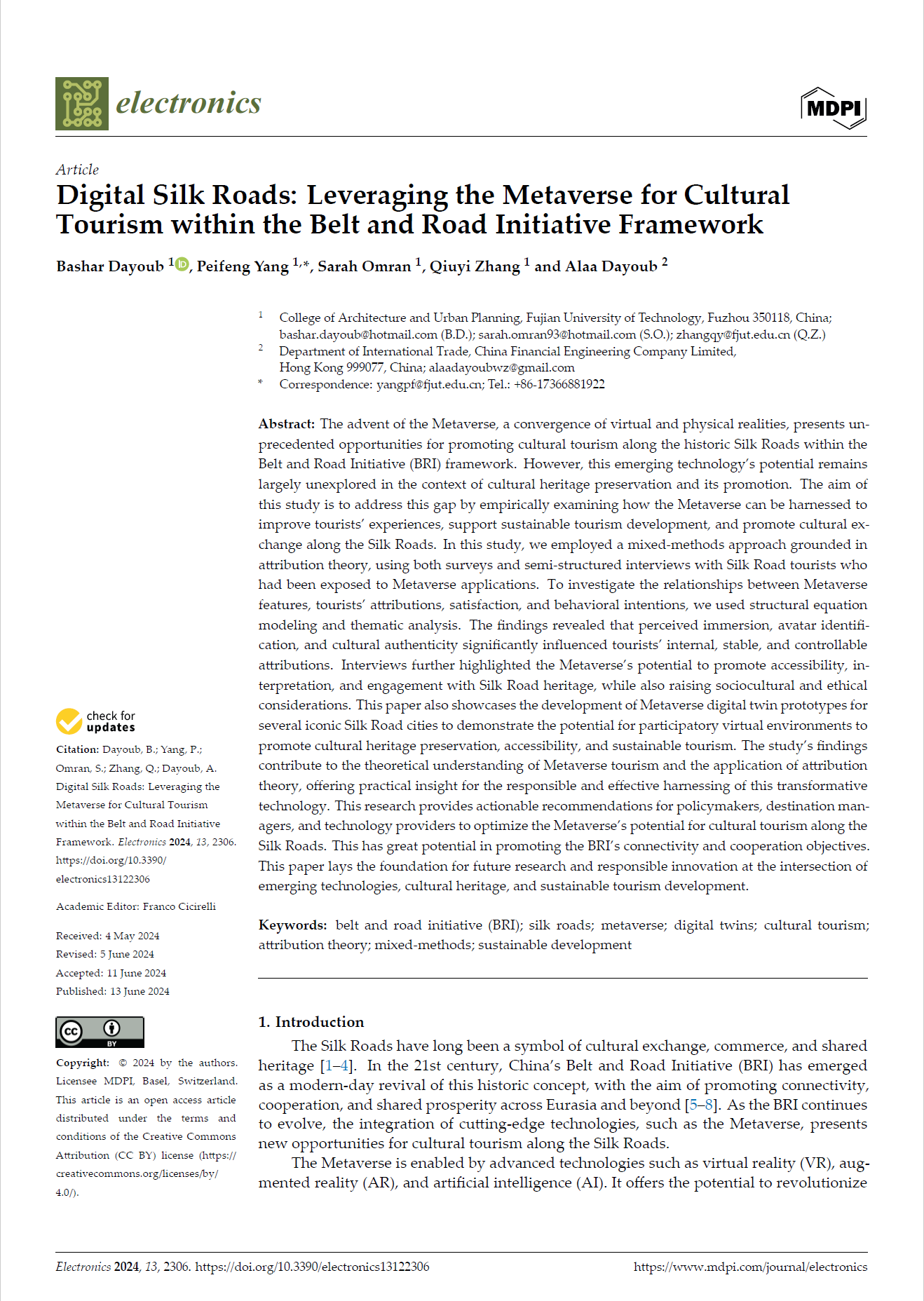
DOI number:10.3390/electronics13122306
Journal:Electronics
Key Words:belt and road initiative (BRI); silk roads; metaverse; digital twins; cultural tourism; attribution theory; mixed-methods; sustainable development
Abstract:The advent of the Metaverse, a convergence of virtual and physical realities, presents unprecedented opportunities for promoting cultural tourism along the historic Silk Roads within the Belt and Road Initiative (BRI) framework. However, this emerging technology’s potential remains largely unexplored in the context of cultural heritage preservation and its promotion. The aim of this study is to address this gap by empirically examining how the Metaverse can be harnessed to improve tourists’ experiences, support sustainable tourism development, and promote cultural exchange along the Silk Roads. In this study, we employed a mixed-methods approach grounded in attribution theory, using both surveys and semi-structured interviews with Silk Road tourists who had been exposed to Metaverse applications. To investigate the relationships between Metaverse features, tourists’ attributions, satisfaction, and behavioral intentions, we used structural equation modeling and thematic analysis. The findings revealed that perceived immersion, avatar identification, and cultural authenticity significantly influenced tourists’ internal, stable, and controllable attributions. Interviews further highlighted the Metaverse’s potential to promote accessibility, interpretation, and engagement with Silk Road heritage, while also raising sociocultural and ethical considerations. This paper also showcases the development of Metaverse digital twin prototypes for several iconic Silk Road cities to demonstrate the potential for participatory virtual environments to promote cultural heritage preservation, accessibility, and sustainable tourism. The study’s findings contribute to the theoretical understanding of Metaverse tourism and the application of attribution theory, offering practical insight for the responsible and effective harnessing of this transformative technology. This research provides actionable recommendations for policymakers, destination managers, and technology providers to optimize the Metaverse’s potential for cultural tourism along the Silk Roads. This has great potential in promoting the BRI’s connectivity and cooperation objectives. This paper lays the foundation for future research and responsible innovation at the intersection of emerging technologies, cultural heritage, and sustainable tourism development.
Indexed by:Journal paper
Document Type:J
Volume:13
Issue:12
Page Number:2306
ISSN No.:2079-9292
Translation or Not:no
Date of Publication:2024-06-13
Included Journals:SCI
Links to published journals:https://www.mdpi.com/2079-9292/
First Author:Bashar Dayoub
Co-author:Sarah Omran
Correspondence Author:杨培峰
Attachments:
Lecturer
School/Department:School of Architecture and Urban-Rural Planning
Administrative Position:Lecturer
Education Level:Postgraduate (Doctoral)
Business Address:Yifu Building, Architecture Department, Fujian University of Technology
Contact Information:bashar.dayoub@hotmail.com
Degree:Doctoral degree
Status:Non-institution personnel
Alma Mater:Chongqing University
Telephone :
email :
The Last Update Time : ..


