
讲师
教师英文名称:Bashar Dayoub
教师拼音名称:61202102
所在单位:建筑与城乡规划学院
职务:Lecturer
学历:研究生(博士)毕业
办公地点:福建工程学院建筑与城乡规划学院
联系方式:bashar.dayoub@hotmail.com
学位:博士学位
职称:讲师
在职信息:非事业编
毕业院校:重庆大学建筑城规学院
移动电话:
邮箱:
最后更新时间:..
 >>
>>
>>
>>
点击次数:
发布时间:2024-06-29
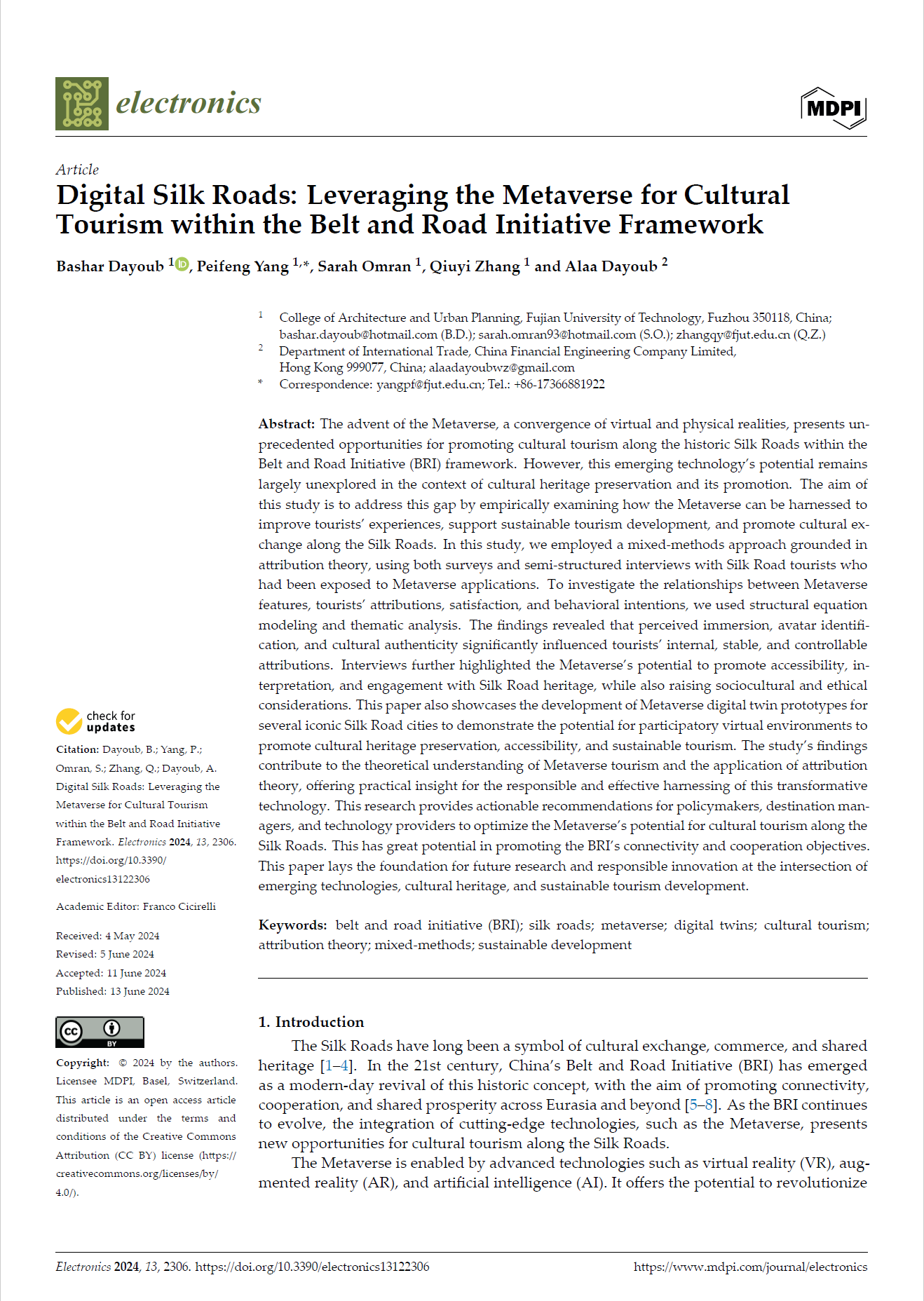
DOI码:10.3390/electronics13122306
发表刊物:Electronics
关键字:belt and road initiative (BRI); silk roads; metaverse; digital twins; cultural tourism; attribution theory; mixed-methods; sustainable development
摘要:The advent of the Metaverse, a convergence of virtual and physical realities, presents unprecedented opportunities for promoting cultural tourism along the historic Silk Roads within the Belt and Road Initiative (BRI) framework. However, this emerging technology’s potential remains largely unexplored in the context of cultural heritage preservation and its promotion. The aim of this study is to address this gap by empirically examining how the Metaverse can be harnessed to improve tourists’ experiences, support sustainable tourism development, and promote cultural exchange along the Silk Roads. In this study, we employed a mixed-methods approach grounded in attribution theory, using both surveys and semi-structured interviews with Silk Road tourists who had been exposed to Metaverse applications. To investigate the relationships between Metaverse features, tourists’ attributions, satisfaction, and behavioral intentions, we used structural equation modeling and thematic analysis. The findings revealed that perceived immersion, avatar identification, and cultural authenticity significantly influenced tourists’ internal, stable, and controllable attributions. Interviews further highlighted the Metaverse’s potential to promote accessibility, interpretation, and engagement with Silk Road heritage, while also raising sociocultural and ethical considerations. This paper also showcases the development of Metaverse digital twin prototypes for several iconic Silk Road cities to demonstrate the potential for participatory virtual environments to promote cultural heritage preservation, accessibility, and sustainable tourism. The study’s findings contribute to the theoretical understanding of Metaverse tourism and the application of attribution theory, offering practical insight for the responsible and effective harnessing of this transformative technology. This research provides actionable recommendations for policymakers, destination managers, and technology providers to optimize the Metaverse’s potential for cultural tourism along the Silk Roads. This has great potential in promoting the BRI’s connectivity and cooperation objectives. This paper lays the foundation for future research and responsible innovation at the intersection of emerging technologies, cultural heritage, and sustainable tourism development.
论文类型:期刊论文
文献类型:J
卷号:13
期号:12
页面范围:2306
ISSN号:2079-9292
是否译文:否
发表时间:2024-06-13
收录刊物:SCI
发布期刊链接:https://www.mdpi.com/2079-9292/
第一作者:Bashar Dayoub
合写作者:Sarah Omran
通讯作者:杨培峰
闽ICP备10022194号-1 福建省福州市闽侯县上街镇学府南路69号,邮编350118

